Open-weight vs closed AI models in 2026
DeepSeek, Qwen, and Llama closed the gap to within 5–15 points of GPT-5.5 and Claude Opus. When the open model is the right call in 2026 — and when it isn't.

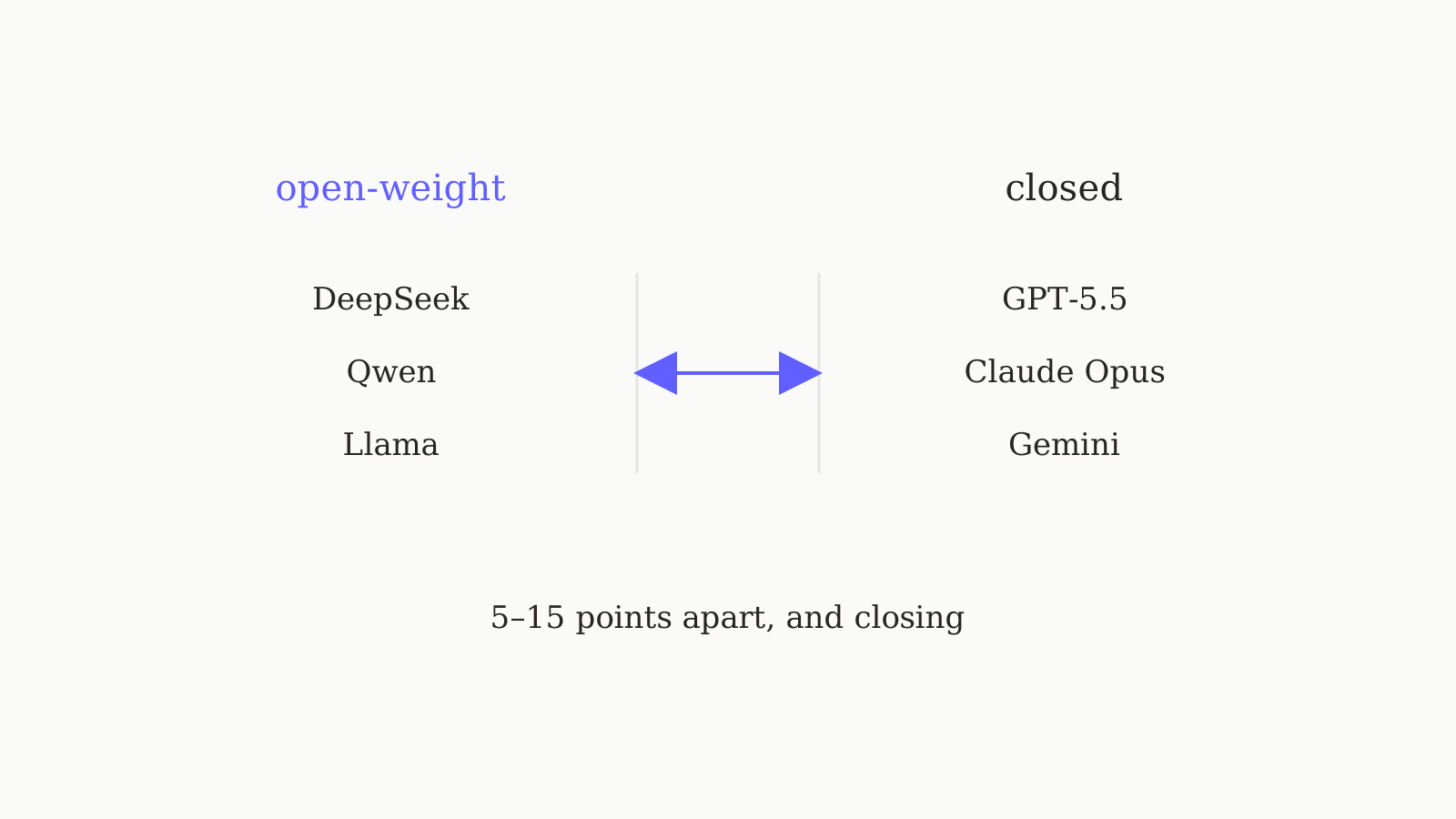
For years the rule was simple: if you wanted the best answer, you paid a frontier lab. In 2026 that rule has frayed. Open-weight models — DeepSeek, Qwen, Llama — have closed the gap to within 5–15 points of GPT-5.5 and Claude Opus on public benchmarks, and on price-performance they often win outright. "Open-weight is the backup plan" is no longer true. But closed frontier models still hold the top of the hardest tasks. Here's how to decide which to reach for.
The state of play, May 2026
| Tier | Leaders | Where it wins |
|---|---|---|
| Closed frontier | GPT-5.5, Claude Opus 4.7, Gemini 3.x | Hardest reasoning, agentic reliability, polish |
| Open-weight quality | DeepSeek V3.2 / V4-Pro | Within 5–15 pts of frontier, self-hostable |
| Open-weight speed | Llama 4 Scout | Throughput and long context |
| Open-weight price | Qwen 3.5 / 3.6 | Cheapest per useful token |
What open-weight buys you
Cost. Run the weights on your own hardware or a budget host and high-volume work gets dramatically cheaper than metered frontier APIs. For a chatbot answering thousands of routine questions a day, this is the whole argument.
Control and privacy. You can fine-tune, inspect, and pin a version that won't change under you. Critically, data never has to leave your environment — which is the deciding factor for regulated, legal, or sensitive workloads.
What closed still wins
The hard tail. The gap may be 5–15 points on average, but it widens on the things that are genuinely difficult: multi-step reasoning, reliable tool use in long agent loops, and the kind of careful, well-calibrated answer you want when the stakes are real. The frontier labs also do the safety tuning for you.
The honest answer: stop picking one
There is no single best model in 2026, open or closed — DeepSeek wins on benchmarks, Llama on speed, Qwen on price, the frontier labs on the hard tail. Committing to one means losing on every axis you didn't optimise for. The better move is to route each task to the model that suits it: a cheap open model for bulk classification, the frontier for the reasoning that matters. This is the same logic behind right model vs best model and picking a model by question type.
How to choose
- High-volume, low-stakes, privacy-sensitive: open-weight (Qwen for price, Llama for speed).
- Hardest reasoning and agentic reliability: closed frontier.
- You don't want to choose every time: route it.
Where this fits
The whole "which model" debate dissolves once you stop treating it as a one-time purchase. For the broader survey of options, read the best ChatGPT alternatives in 2026. And if you've ever kept paying for a model you didn't fully trust just to get a second opinion, keep a model you don't agree with makes the case for why that instinct is right. oran.chat exists to route across the strongest model per question instead of betting on one — start free. More comparisons live in Comparisons.